Checkout wasn’t until 2:00, so we took an “easy” hike from the campground through a forest, then across a fen. Martha explained to me the difference between a bog and a fen. Water doesn’t move in a bog, but does in a fen. I wore my bug shirt this time, and the mosquitoes were sure trying to get in. The problem is you get hotter. It would be much more comfortable in shorts and a t-shirt, but that is not an option.Â
Back at camp we fixed lunch. I watched two guys across from us pull their big all-one-unit camper out of their site and run into a tree and the post marking the site. It was hard to watch. Then they backed up and did it again! I moved my truck so they could pull across, back up and have a straight shot out. They knocked off a tool box on the side, and I’m sure scratched up the shell. The site was at a 45 degree angle the wrong direction for a one-way road, but still…! It made me very nervous to hook up and get out safely, but thankfully, we made it.Â
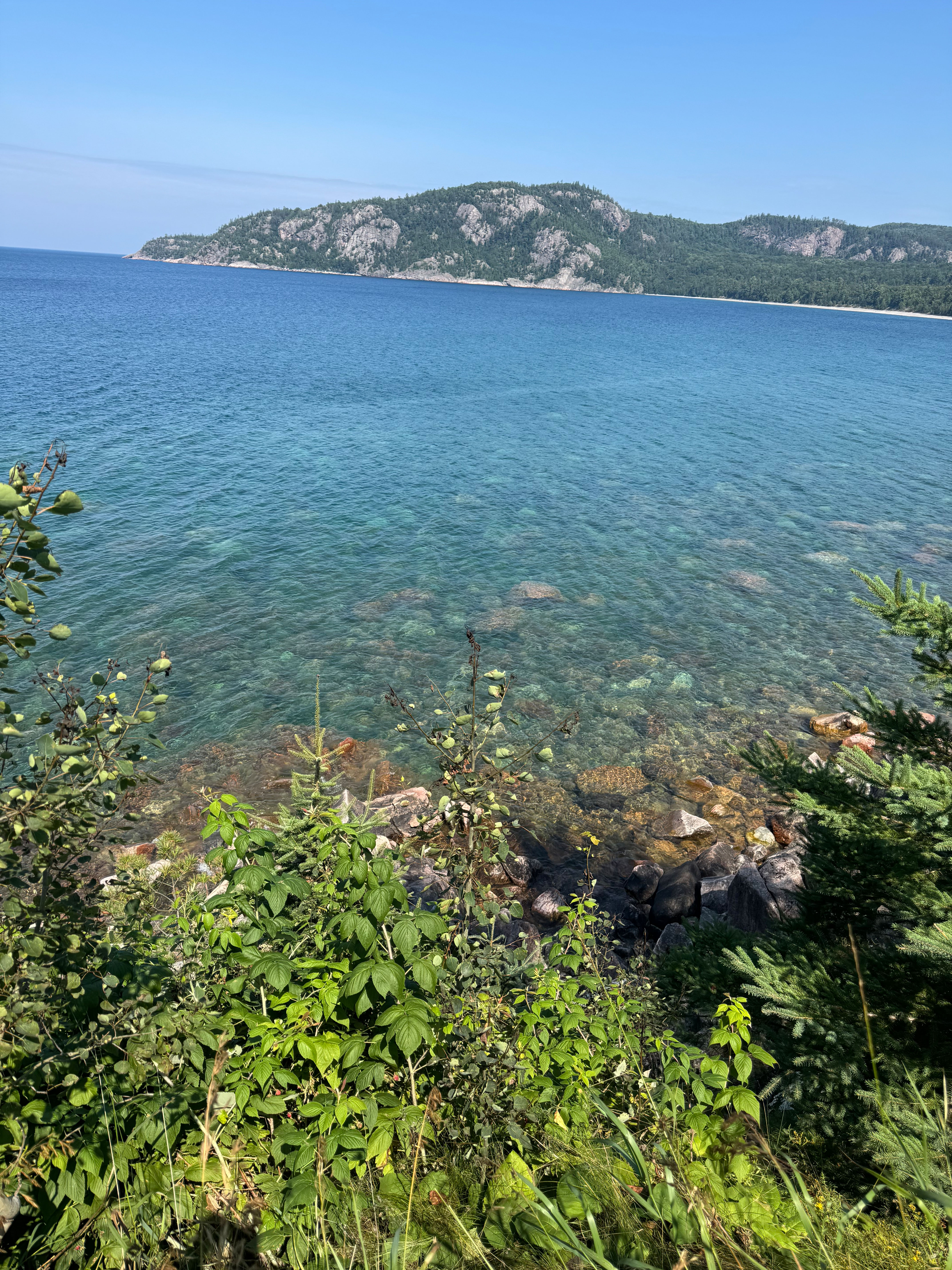
The drive from Pancake Bay to Rabbit Blanket in Lake Superior Provincial Park is only an hour and 15 minutes, but there are beautiful views of the biggest fresh water lake in the world. We stopped at two overlooks to see such clear water, we could see all the different colored rocks on the bottom.
I talked to a man in a big, old Class A camper – the kind you drive. It looked like it had been around the block a few times. He said it was a 1991, and they were just coming back from a trip into the Yukon. When he started the big diesel, it sounded great! I gave him the thumbs up as he pulled out.
At the next overlook we met a man who was riding a bike across Canada all dressed in pink. It has taken him 10 years, but this trip will take him to Toronto, which is a bit less than 900 miles from here! He had his campsite reserved, and was ready to get to it on his new Trek bike. To do this and carry clothes for all kinds of conditions and camping gear and food and water adds up to a lot of weight. You might guess this is flat land, but it is very hilly with small mountains.
We passed so many beautiful rivers and lakes beckoning us to come float and explore. We stopped at the Lake Superior Provincial Park Visitor’s center, taking in all the exhibits. Then on to Rabbit Blanket, a very nice campground on a very pretty lake. We walked around to explore before returning to our site, which by the way had fresh bear poop and black fur right behind where we parked the trailer.
Gear: Candle lighter. I love this thing. It is a rechargeable candle lighter. I love sitting by candle light, writing in the early hours. I also light the stove with it so I don’t wake Martha with the loud stove clicker. Disclaimer: I make no money from this blog.
We did two loads of laundry at the Sault Ste. Marie KOA before hooking up. Bill and Joan have everything you could ever need at this campground, including a trailer wash, and it’s all in top shape. We did our grocery shopping yesterday, and filled up with gas. It’s not like we are going into the wilderness, but we will be in provincial parks for the next five weeks.
It is only 40 miles to Pancake Bay Provincial Park, and check in isn’t until 2:00, but first a visit to McCauley’s Motel in Havilland Bay. We were lucky to get right through the construction area, which saved us 30 minutes. Although I paid $8 for a little magazine for the “Lake Superior Circle Tour,” it lacks in detail. We passed beautiful Chippawa Waterfall right beside the road with no turnout or warning. Then there was a fabulous view of Lake Superior with mountains in the background, but there was no scenic overlook. I will have to be more alert and quicker on our next drive.
Pulling into McCauley’s Motel, so many memories came back to me. Kelly had seen a fishing show on TV where Ady was advising the fishermen where to go. We parked next to the spot Ady had let us camp for 5 days for free. We had a very large decal made by Mike Chanail with “Fish Across Canada” below. Ady said it would be good advertising for him. It was a famous fly shop, run by one of the great characters and gentlemen of fishing. He had it all; maybe a hundred rods hanging from the ceiling, a huge supply of flies that he tied himself (“What else am I going to do in winter?”), a whole wall of fly-tying materials, reels and so much more. It was just fun to wander up and down the isles. Kelly describes this well in his book, If the Fish are Bit’n, which you may still be able to find on Amazon. Ady helped us so much, telling us where to go and what to use. Later on the trip, we would call him to tell him where we were and what we were doing.Â
We knew Ady had passed away, but with some vestige of hope, we walked toward the building. A lady called out to us, “Can I help you?” She was very nice, telling us the motel and all had changed three times just since she had worked there 8 years ago. The fly shop was now part of the motel, where groups could stay. The restaurant was only open for dinner, but is very busy, and the motel stays booked all the time. She didn’t know anything about Ady or the fly shop or where everything went. I gave her (Theresa) my card in case she heard anything about where Ady’s merchandise went. She said two McCauley sisters still lived in town, so she would ask around. She suggested a place for lunch as we headed out. Martha took a picture of Theresa and me wearing my treasured Misty Mountain Fly Shop hat.
Greg and Teresa
the old Misty Mountain Fly Shop
We stopped at Theresa’s recommended place, The Voyageur’s General Store, and ordered whitefish tacos, which were delicious, and came with a huge order of French fries. Next door we bought one of their famous apple fritters. Even with splitting everything, it was more than we could eat.
It was too early to check into Pancake Bay, but we tried it anyway. A nice young lady checked us in, telling us how to get to our site. It is a huge campground, and it was full. It was full when I booked it four months ago, but I took a spot way in the back. Baking into the site, I struggled to navigate with trees blocking me in front. Finally I got to a reasonable spot only to discover a muddy place next to the trailer. We decided to put the trailer on top of the muddy spot, but that some wiggling too.Â
Pancake Bay PP. Site 6. A little muddy
After setting up, we chilled for a while, then went down to the bay to see what it was all about. It was a huge 3.2 km. C-shaped, white sand beach. Kids were playing in the shallow water. One had already mastered his paddle board. People were playing corn hole and some other game where they bounce a ball off a small trampoline-like ring. With a perfect 73 degree, sunny day, many were just sunning themselves or reading a book beneath their umbrella.
Pancake Bay
Really, really clear water
We decided to walk to the point on west side of the beach. After walking 30 minutes to the point, it was clear why this was such a popular place. It is one of the prettiest beaches I have ever seen. Beautiful, soft sand with some smooth, round rocks for decoration, crystal clear water and shallow depth add up to enjoyable conditions. Shallow depths allow the water to warm in the sun, so I decided to test it. It wasn’t a hot day and the water was chilly. I came to a drop off and took the plunge. It was quite refreshing, so I did it a couple more times before wading back out. There wasn’t much wind, so I didn’t have to dry off. It all adds up to pretty perfect conditions with gorgeous scenery.
The Trans-Canada Highway (Rt. 17) crosses the Goulais River northwest of Sault Ste. Marie. The river is surrounded by The Goulais River Provincial Park, which has no facilities. Reports are that the river supports a sjstainable Brook Trout population and it is wadable.Â
First step was to get a non-resident fishing license. Those of you who read the “Fish Across Canada” blog 12 years ago might recall our rants on Canadian Fishing Regulations. You have to be a Canadian lawyer to keep up with them. If you are lucky enough to fish across Canada for four months, you will find that every province is different. Every river is different. Then there are different regulations for sections of the stream.
My online license registration for Ontario asked for the usual information. Then you must buy and carry a hard card, which will be mailed to your home!?*# So I put the hard card in my basket. Next, do you want a Sport Fishing license or a Conservation license; 1-day, 8-days, 1-year. Well, I am here for 7 weeks, so I guess I need the 1-yr license. The sport fishing license allows you to keep more fish, while the conservation license allows you to keep fewer fish. Well, the taste of a wild Brook Trout made me look further.
On the Goulais River, with a Sport license you can keep 6 Brook Trout in a day, but with a Conservation license, you can only keep two, but none over 18 inches. That’s good with me – two for dinner, and I will return the other 18 to the stream. So I paid the $8 hard card fee and a $53 fishing license. The 6 fish/day license was $83. I printed the license on my amazing, little Canon printer that only gets used once a year, and it was purchased for this specific purpose 12 years ago, when we had to have a license in every province and often a special regulations permit. So this little Canon printer is stored in a hot or cold trailer, never being removed, and it printed perfectly.Â
I invited Martha to join me, sure that we were going to see some beautiful country and catch a bunch of my favorite fish of them all, the mighty Brook Trout, which is also the best tasting fish. As we drove west, I decided I would stop after catching 20 fish, only keeping two.Â
Four miles from the KOA traffic was stopped on the two-lane Trans-Canada highway. Road Construction. It looked like a section got totally washed out. Imagine the vast expanse of Canadian roads that are subject to snow, snow-plowing, ice and flooding. Lately, add fires to the list. Anyway, here we sat for 15 minutes while the traffic in the other lane passed us. I was reminded of someone telling us there are only two seasons in Canada, winter and road construction.Â
Finally, we were through and turned on Rt. 552 that follows the river a long way. The road wove through big hills or small mountains. The river was indeed beautiful. I passed up two very pretty access points due to cabins and houses nearby. Too much pressure on the fishery, I quickly surmised. We climbed up a mountain, leaving the river way below us, and the road turned to gravel. Finally it came back down to river level with a pull out and a gorgeous waterfall, or what they call the chutes. Although we didn’t see any, the river is a popular canoeing destination.Â
We found a place to park and I anxiously geared up. Martha was quick to comment that, “Kelly would be fishing by now!” True, but how would she know that? I mean i had to put waders on, put my rod and reel together, get my fishing vest and see what fly boxes were in there. Ahhh, Royal Coachmen, the perfect fly for Brook Trout. Probably wouldn’t need anything else.
I took out a chair for Martha to sit on a gravel bar and relax while I showed her how it’s done. Three trailers had what appeared to be a permanent position next to the river. I thought it was a provincial park! There was a fire pit and kids’ toys scattered around. I worked the Coachman with my 5-wt. Orvis rod. It seemed to be one of those rare days I was throwing it well. Of course I was totally unobstructed by trees or bushes as the river was 40 yards across. With no action, I worked my way across the 2-foot deep stream to the other side, working a run on the far side. Martha seemed content reading a book. It is a beautiful stream with an impressive waterfall ahead.Â
Nothing. I climbed over some huge boulders to the plunging hole beneath the waterfall. For the third time, I changed flies to something that would get down. Nothing. I noticed car tracks on a gravel bar leading to a road encroached by bushes. On the gravel bar, a healthy green plant grew with beautiful blue berries. Using Picture This app, it was identified as sand cherry, mildly toxic to humans.Â
So this beautiful spot is a popular destination in summer and likely in winter. I thought of 12 people coming for a weekend, catching 6 fish apiece per day! They need a new regulation for this section, and restock it. We got back in the truck and drove down to another pretty access point. I fished several flies, even a dropper nymph, but no luck. The water didn’t feel cold enough for Brook Trout – maybe years ago before all these cabins and trailers and warming temperatures.
It’s a lovely river and no doubt, a good one to float and take a swim in. Maybe another 20 miles up that gravel road we would have done better. Who knows? Back on the Trans-Canada Highway, we waited in line at the construction site – two cycles. Martha could have gotten a bike out of the back and ridden back to camp faster than I got there. Oh well, may as well get used to Canada’s two seasons.
The #1 TripAdvisor recommendation of things to do in Sault Ste. Marie is the Bushpilot Museum. I love this place, although it has changed with more emphasis on fighting fires, which is no doubt a huge issue today.Â
The museum as we saw it 12 years ago, focused on individuals exploring Canada after the invention of flight. Up until then, exploration was done by canoe. That requires a level of toughness I can barely comprehend, especially in winter. When flight entered the picture, things may have gotten physically easier, but brought increased requirements of navigation and survival. Like the wild west, it took a certain breed to want to tackle immense challenges. No one is coming to get you should something go wrong.
At the entrance is a camp set up to resemble maybe a 1940’s to 1950’s fire fighting campsite. Just a basic camp was a load to carry in a small plane, and this was a well-equipped camp with a big canvas tent, axes, saws, etc. Most would have gone to hunt, fish and explore. Imagine the game in those days!
Today the focus is on fire-fighting, which has its own requirements for bravery, flying and fire-fighting skills. A good movie puts you right in the middle of the fight with all the modern communication and fire-fighting planes. Just the skills required to scoop up water from a lake, and then dump it on just the right spot, and you have to be accurate. They call it precision bombing.
The museum has many more planes than were there 12 years ago. In those days it was run more like a club. Volunteers who loved flying, history and the exploration of Canada, worked on and restored all the planes. They bragged that every one of them flies, and they were anxious to show you around. I was disappointed not to see any of those men today, but it is still the #1 thing to do in Sault Ste. Marie. You will know where it is when you drive down the street and look up to see what looks like an old plane about to land in the street.
First flight in Canada
Movie theater
Canoes made in sections so they could be carried on plane
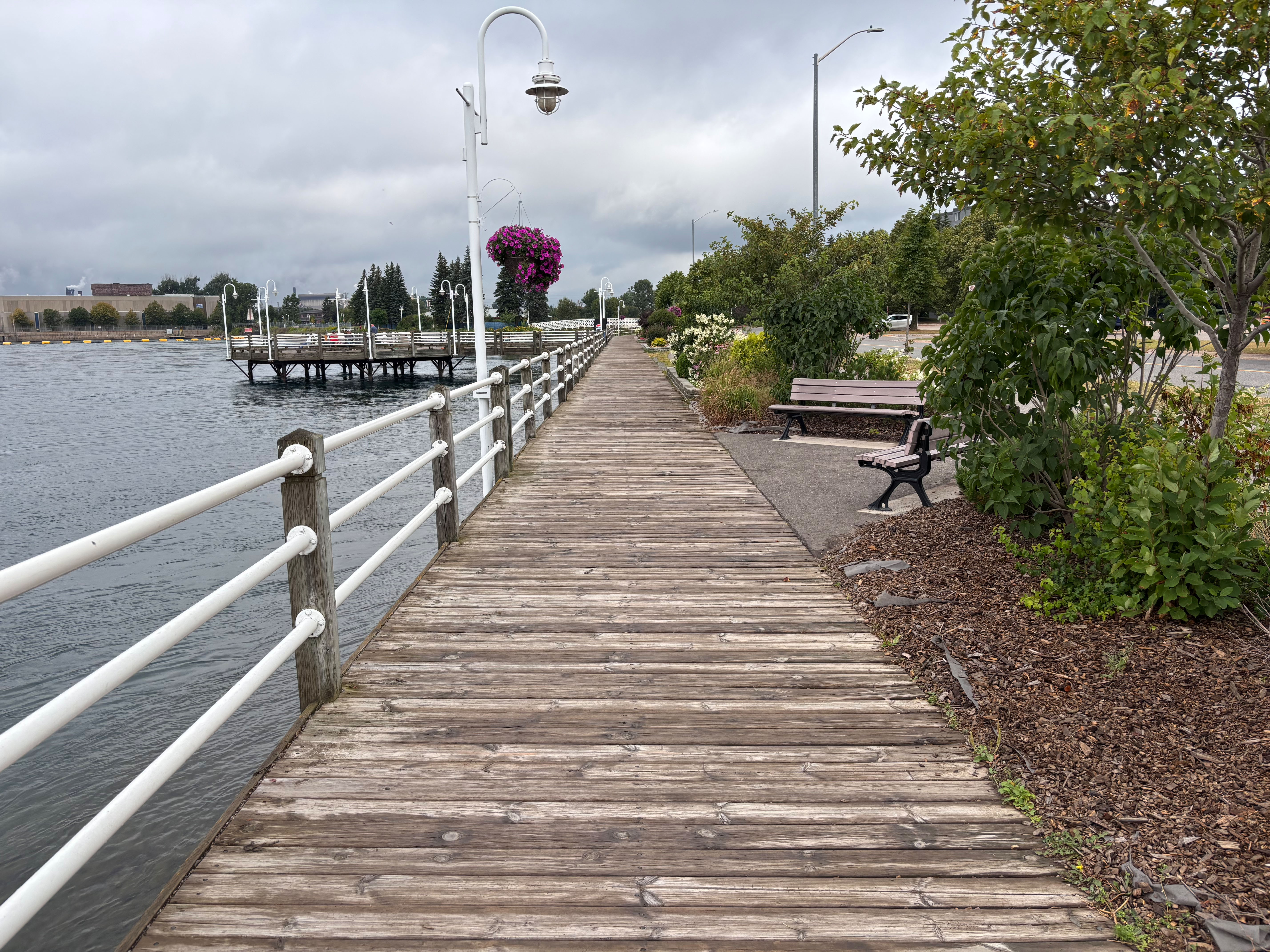
After four days of driving, we wanted to get out and walk. #2 on the things to do in Sault Ste Marie is the Boardwalk along St. Mary’s River that connects Lake Superior to Lake Huron. It is a busy area for Great Lakes shipping both with loading and unloading as well as locks to move ships between these lakes.
The boardwalk is planted with beautiful flowers. Bikers, walkers and runners passed us on our walk. Passing a hydro-electric plant, we came to the locks where Kelly and I had observed people steelhead fishing. Whitefish Island has been a productive fishing area for many generations. Indian tribes came here every summer for the whitefish, netting and trapping them.
Following the trail down to the river, chipmunks came out to greet us. A rabbit hardly looked up as we walked by. Birds flitted between bushes. A creek runs through the middle of the island, but locks and hydro-electric facilities have all but drained the flow. That didn’t stop beavers from making four dams.
Surprisingly, the river was flowing strong, much more than our last visit. There are so many fires in Canada in very dry conditions, I thought water levels would be low. I love this spot!
Not far from the KOA is a unique lunch and takeout place called The Soup Witch with fresh-squeezed lemonade, espresso, sandwiches, chili, pies and more.
Having a little history, I don’t like border crossings. With another day of travel, we drove through Traverse City, recalling our previous visits to this city. It was a 4-hour drive pulling the Airstream, and not a bad one. There was very little traffic along I75 to the Mackinaw bridge across the Upper Peninsula of Michigan, better known as “The UP.” Traffic did get backed up to pay the bridge toll. Martha pulled out a credit card, saying it would be faster than cash. I questioned if they would take it, but she was right. EZ Pass would have been a LOT more efficient.
Anticipation grew as we drove toward the next bridge. The land was wide open with a few farms. It looked like moose country, but with 92 degree heat, any moose would be sleeping in the shade. We paid the $8 fee for truck and trailer and crossed the St. Mary’s River. Below were all kinds of locks to transport ships between Lake Huron and Lake Superior. There is a good view of Saint Mary’s Rapids where people fish for steelhead.
Only a few cars were lined up to go through customs in Canada. I didn’t know if that was good or bad. The agent asked if I knew where my license tag was from as he examined our passports. “Are you carrying any guns? Where are you going? How long will you be here? Have a good time.” I smiled, thanked him and drove on.
The roads were rough, buildings run down or abandoned and businesses closed, not a good sign for a major entrance into Canada. We drove north of town to the Sault Ste. Marie KOA, where Kelly and I stayed 12 years ago on our Fish Across Canada trip. Bill and Joan still run the place, although a couple of young adults greeted us, one guiding us to our sight. The campground has grown a lot since our last visit, but they have all the amenities – showers, laundry, swimming pool, trailer wash, air station, putt-putt and more….and they charge appropriately.
We got a shower before a thunderstorm came through. Although there is cable TV, we couldn’t find anything worth watching, so we were off to bed early.
We set out to explore Lake Superior, some parts of which Kelly and I saw on our “Fish Across Canada” trip in 2013. It was so foggy on that trip, we couldn’t see 20 yards in front of us. The old days of traveling without reservations are gone, so I have booked campgrounds all along the route for a 7-week trip. Hundreds of fires are burning in Canada, including Newfoundland. We thought about cancelling, but decided to go. We could always turn around at any point.
We set out on I64 to 35N to Columbus, Ohio, parking next to Ed and Debbie McGlumphy’s home. Ed gave us a tour of his Clear Choice office, which is an amazing business utilizing the latest technology and teamwork to provide teeth for those who are losing their own. With two prosthodontists, a surgeon, two laboratory technicians and an excellent staff, they are able to remove diseased teeth, place implants and restorations all in the same day.
We had a nice visit and dinner at the McGlumphy home. Kellye and Nick, Nancy and Medic came over to join us. We walked down the street to see Kellye and Nick’s new home. Of course they were very excited and have lots of projects they are working on. Upper Arlington is a great neighborhood with a nice park and good schools. It’s hard to beat.
Debbie got up at 4:30 to go workout before a day of teaching at the dental school. Ed was off to work before 7. By 7:30, we were off to Michigan. I didn’t want to drive I75 and 23 around Detroit, but next time I will. It was only an hour longer to go 35 to Fort Wayne, over to 131 to Grand Rapids and Cadillac. I think we pushed some setting on the GPS that led us to the most convoluted route possible, zig-zagging around construction sites, backroads, 1,000 turns, which at one time led to a low hanging bridge of 9’10”. Fortunately I didn’t make that mistake again, but it took a lot of work to get back on track. What should have been a fairly easy drive turned into a grueling day.
We stayed at Camp Cadillac Campground, which was pretty full. We didn’t want to cook, so we went to Lakeside Charlie’s for dinner. Cadillac is an interesting town that is built around lovely Cadillac Lake.
After a good night’s sleep, we went to the Farmer’s Market, which is pretty unusual for a Friday. We walked through a pretty, little park and out to a pier into the lake with black ducks swimming all around. It is a very pretty lake with clear water. We walked back to the park, crossing railroad tracks that appeared to still be in use. The train station, however, has been converted to a restaurant called After 26 Depot. We peeked inside to see a nice, busy restaurant, especially for a Friday morning. Outside, two vendors engaged us with easy conversation. The nice lady told us about the restaurant, saying it was very good. It was started “by our organization” to employ learning disability adults (after 26 years old).
Across the street the farmer’s market is in a covered, open air pavilion. It was just the right size really. There were great-looking fruits and vegetables, and lots of corn, but we weren’t sure of the restrictions for crossing into Canada. As it turns out, there are fewer restrictions now. Martha loves a farmer’s market and made the circuit once before making her final choices.
Returning to camp, we hooked up and headed north to Leland, Michigan to visit David and Beth Sutton. We checked into Wild Cherry Resort Campground. Resort usually translates to a more upscale campground with amenities like swimming pool or golf course or on the water. This one has generous sites with pretty surroundings and a lake in the middle. There are no showers or bathroom facilities. The owner greeted us, and when asked, he said, “I didn’t want to clean bathrooms.” Can’t blame him for that.
Camp Cadillac
Fishing pond
Martha took a nice nap before we drove over to the Sutton’s. The whole family enjoys Leland, so it makes a great family gathering with three grown children and 7 very cute grandchildren. We toured the work they are doing on the big house and “Granny house”, then walked over the beach on Lake Michigan. On a very hot day, they were all enjoying the water. Max, their handsome yellow lab, swam around splashing water with his paws, then catching it in the air. Later he followed a lady throwing a ball for her labradoodle. David had to go retrieve him.
We walked over to Gordon’s house and waited for him to return with his new pontoon boat. He told us about their success fishing for smallmouth yesterday with a few pictures to prove it. Gordon got off at a restaurant to meet the family and David took over for a tour of Lake Leelanau. Beth and her family have been coming here since she was a kid, so hearing her stories, along with the history of the town were very interesting. As she said, people came here for the fishing, and for cooler summer temperatures.
Slowly, we went through “The Narrows” and a marsh where swans were nesting. The lake is shaped like an hourglass with a bridge crossing at the narrowest part. Our campground was just east across the bridge. After a bit of searching on a busy Friday evening, we found a place to park, and walked up the hill to a restaurant called Dick’s Pour House. With Max joining us, we were fortunate to find a table outside. Two entertaining ladies waited our table. While she told us stories of her dogs and their troubles, I examined her tattoos and teeth.
Beth ordered Walleye and Martha and I follow her lead. David also ordered a plate of smelt, which you don’t often find. A sardine-sized fish, they were good. The Walleye was very good and a generous portion. A beautiful, full moon rose as we started back up the lake. How David found his way back home, I don’t know. There are no headlights on the boat, so we traveled slowly, looking for channel markers. After docking, we tried to scare Lucy through the window as she read a book, but she just waved us off. We thanked David and Beth for their hospitality and found our way back to camp.
On the last morning, we needed to pack up and get out of the cabin because all the St. Marie family was coming. There were a couple of messages about the float plane not being able to get out due to low ceiling. Thankfully the flight from Labrador City to Montreal was moved to 6:30. Once packed, I took my last tour of the lodge with interesting things in every corner. I walked down the dirt road to a bay, then walked the other direction to the sawmill. It’s pretty amazing to get all this stuff to this remote location. There is no Lowe’s. Yves had to cut trees before milling them into lumber to build the lodge, cabins, docks, generator house and workshop.
I’m going to miss this!
“The office”
All those dots on the hillside are Caribou
Communication system
Smoldering smoke stove to keep bugs away
The above picture is a story! Yves discovered this WW2 B52 bomber on the bottom of the lake. Divers. Divers attached airbags and floated it to the surface and it was pulled 90 miles, very slowly to town. The U.S. took it, rebuilt it and put it in a museum. Apparently the navigation system failed and they missed landing in Goose Bay.
Expanse of water, lakes, bays, islands and smoke from distant fires.
This has been an expensive trip, but a great one. We didn’t catch a hundred of the great Brook trout, but we caught some beauties, and they are an amazing fish. This vast expanse of water, lakes, islands, trees and bears is a wonder. I was appreciative of our guide, Michelle, who guided us safely every day. I am in awe of Yves and Pattie St. Marie for all they have done to build this place and to keep it going. They are two of the nicest people I have ever met. Their season is only two months long, and most things have to be flown in, or brought on sleds on frozen ice of winter. It was great spending time with Ron. I always learn a lot, and the stories of his many adventures are legend.
I would like to explore more of Labrador. Two months of driving the only road in Labrador would be very cool; then back on a ferry on the St. Lawrence. I’d like to explore Torngat Mountains National Park, and I’d like to catch more Brookies!
Our last day would be our best fishing day. We caught 15 Lake trout and 6 or 7 pike. In the bay where we caught most of the Lakers, a bear cub followed us around the shoreline. We were about to give him a fish when we saw his mother with two other cubs. Michelle said these were likely the ones we had seen a couple of days ago.
It was a weird day. the sun poked through a hole in the clouds, but the hole didn’t move. About 2:00 Michelle told us to put on rain-gear as it was pretty dark in the west. At one point Ron said he smelled smoke. Michelle and I didn’t smell it at first, but later we got a whiff of smoke.
It’s a little sad to think this was our last day and our last wonderful meal by Patti. Like all adventures, it wasn’t how we envisioned it, but in many ways it was so much more than we could have imagined. Mostly it was the kindness and humility of these people. What they have built here is amazing. The vastness of these waters is cool on one hand and frightening on the other. Yves said many have gotten lost on these waters. Without the right equipment, you could be in serious trouble. Even Michelle used a Garmin GPS at times, and he has a satellite phone in his backpack and a lighter on his belt. with the waters being so low, islands of rocks popped up in the middle of the river where they are usually not seen. Hit one of those going full speed and things could go bad in a hurry. I admired Michelle’s vigilance, always paying attention, reading the water and the sky.
Every day starts with a great breakfast. Yves and Patti are a delight to be around. By now we had heard bits and pieces of the story about them building this lodge 90 miles from Labrador City. Yves came out in winter, pulling equipment, including a sawmill, and built the lodge in 39 days! He cut the trees, them cut into lumber and built it. Caribou were here in abundance. Huge black bears, like the huge Brook trout, grew here.
“Between the 1950s and the 1990s, the George River herd grew and grew — from about 15,000 animals to more than 800,000. When the ban took effect in 2013, the herd was estimated at 70,000 animals. Population estimates earlier this year put the herd at under 10,000 animals.” (https://www.cbc.ca/news/canada/newfoundland-labrador/herd-inuit-caribou-documentary-1.6549493).
It is especially devastating to the Inuit people whose lives are intertwined with the Caribou. Some disease seems to have devastated the herd. The effect is not unlike the loss of the plains buffalo in the U.S.
As I walked down to the boat, I passed Yves in his workshop/tool house. I commented that I had never seen such an organized workshop. He smiled and said it has been a process. He has been robbed several times. He reinforced the front door with steel, but they hooked the back door to an ATV and pulled it off. They came in masks and cut the security camera wires. They shot the satellite dish, broke into the lodge and took cushions to put the motors on. Out here in the wilds, this is a difficult thing to prevent. They followed the tracks back toward town, but when they got close to the town, tracks were going everywhere, so they lost the trail.
Then there are the bears. This morning I noticed two white things in cellophane next to our front door. I thought they were peppermints. Perhaps someone thought we had bad breath. Then when I went over to the lodge, they were in all the windows. Yves said they were moth balls to keep the bears away. Last week Patti had put an apple pie in the window to cool. A bear came and ate it, then tried to get in the window, so Yves had to shoot it. Now she cooks with the back windows closed, so it gets a bit hot.
If you fish enough, you are going to get tangles!
Due to a fire ban, this was the first day we had a shore lunch. It is in a beautiful spot with great views. Pike, cod, potatoes, toast and onions.