I got up early, fixed some coffee and listened to some birds not far away. Although I couldn’t tell what they were, they sounded big. Looking at Google Maps, I saw a big lake or inlet next door. There was also a creek close to my camp. No wonder there were mosquitoes. I drove out of the park, turned right and followed South Railroad Avenue going behind my camp site. There was a train track on the other side of the road.
The Gulf from South Beach Blvd.
As I slowed down to look at the big estuary, a man got out of his car in front of me. I pulled over behind him, thinking I would take pictures of some egrets or something similar, but there were none. The man started rigging up a fishing rod, so I walked up and asked what he was going to fish for.
In his mid-sixties, he put a Hula Popper on as he told me he came here every morning for an hour’s fishing while his wife slept. He said he sometimes caught sea trout, flounder, largemouth bass and drum. “OK”, I thought to myself. “I think I’ll hang around and watch.”
This guy was a pro. He had a Daiwa rod and a Japanese reel, braided line and a tippet he tied onto a loop at the end of the line. As we talked, he must have thrown one of two lures 200 times, and never got caught in the grass once. He could throw that thing a long way with a two-handed grip with the lure dangling 2.5 feet below the end of the rod. He knew the currents and the wind, so he threw it past and left of a point. The current would carry the lure right past the point. It was pretty-much high tide, his favorite time to fish.
Fish began jumping to our left and further out. I suggested he needed a boat. “Ahh, I used to have one, but now I’m too old and sore to pull it out. I sold it last year.” The jumping fish were bait fish trying to escape some predator. Sea gulls cried above, swooping down to capture some.
Finally, we introduced ourselves. Stephan Champagne (pronounced with Creole accent). He was born and raised in New Orleans, but traveled a lot with business. He worked with the railroad for years, and said this is still a busy line carrying all sorts of goods – whatever someone wanted to have shipped. He worked in Newport News for a while, installing a system for ship building that was a big success.
Finally he got a hit – a good one. He had switched to some 2.5” topwater crawler he gave me the name of, but I no longer remember. It was a very nice trout. He quickly dispatched it with a knife to the spinal cord and threw it into a cooler. “Dinner”, he said with a smile. He said he preferred topwater lures. “It’s just more fun.”
After a few more casts, he looked at his watch. His wife would be getting up, so he started packing up, and we said our goodbyes. I enjoyed my morning with Stephan, and I think he liked having some company. I liked his stories as well as watching an expert fish. He talked about his 40’ mahgany trawler he bought and restored. He and his wife enjoyed traveling in it for about 7 years before he got tired of throwing money at it.
I stood looking at this pretty piece of water, imagining a nice fishing kayak, maybe one you power with your feet. Maybe I could get to the other side where all the fish seemed to be. Then again, maybe Stephan was right. Drive up, throw lures for an hour in the early morning, watch the gulls and maybe take a nice fish home for dinner.
The day began with Red and White Market sausage, eggs and pancakes. That sausage is so good!
Mt. Pleasant/Charleston KOA is owned by adjacent Oakland Plantation, which has been in the family for several generations. At 236 acres, it isn’t big, but it is very pretty with its Oak-lined entrance. The campground provides a free tour of the property in a tractor-drawn wagon.
Since Ruff ordered the best drink, we had to try it
Mark Zablotsky (https://www.markzphotoworkshops.com) had recommended Magnolia Gardens. I knew little about it, except that there is a 60 acre Audubon Preserve. A big sign in front listed all the tours. Martha asked what I wanted to do, and I said, “All of it.” We started by walking through the extensive gardens. Extracting from https://www.magnoliaplantation.com/magnolia_history.html,
“Some time later, while in England preparing for the ministry, young John Grimké Drayton received word that his older brother Thomas had died on the steps of the plantation house of a gunshot wound received while riding down the oak avenue during a deer hunt. Thus, having expected to inherit little or nothing as a second son, young John found himself a wealthy plantation owner at the age of 22.
Despite the prestige and wealth inherent in ownership of Magnolia and other plantations, he resolved still to pursue his ministerial career; and in 1838 he entered the Episcopal seminary in New York. While there, he fell in love with, and married, Julia Ewing, daughter of a prominent Philadelphia attorney. Returning to Charleston with his bride, he strove to complete his clerical studies while bearing the burden of managing his large estate. The pressure took its toll, and his fatigue resulted in tuberculosis. His own cure for the illness was working outside in the gardens he loved. He also wanted to create a series of romantic gardens for his wife to make her feel more at home in the South Carolina Lowcountry. A few years later, as though by a miracle, his health returned, allowing him to enter the ministry as rector of nearby Saint Andrews Church, which had served plantation owners since 1706 and still stands just two miles down the highway towards Charleston. But until his death a half-century later, along with his ministry, Rev. Drayton continued to devote himself to the enhancement of the plantation garden, expressing his desire to a fellow minister in Philadelphia, “…to create an earthly paradise in which my dear Julia may forever forget Philadelphia and her desire to return there.”
After walking through the gardens, we took the house tour. No photographs were allowed. Although the house isn’t grandiose, it is comfortable, and the huge porch is wonderful. The original home burned three times, once by Union troops. It was rebuilt as a cabin at first, then gradually, additions were made. The property is still owned by the family through 12 generations.
“After the Civil War and through the Civil Rights Movement Magnolia continued to function, though in a distinctly different way. Among the many challenges was establishing a new relationship with the formerly enslaved workers who remained on the plantation as sharecroppers, tenants, and day laborers. All of Magnolia’s residents worked to find a new level of social and economic understanding and accommodation. The plantation’s main house was rebuilt in the 1890s. Increasingly mechanization would replace the need for tenant farmers; what began in the 1930s was accelerated by World War II bringing the end of plantation agriculture at Magnolia. In spite of difficulties the African American community still maintains a strong presence in the Cane River region. Traditions rooted in African, French, Native American and Spanish influences give this area its character.”
Next we hopped on a trolly that would take us through the Audubon Swamp. They have built ramps in the water where alligators, birds and turtles sit. The trees were loaded with roosting Egrets, Great Blue Herons and Anhingas. John James Audubon spent time here, studying and painting wildlife. Some of his work hangs in the house.
Ducks chowing down
Gator in the duck weed
Slave quarters
Fortunately, we brought sandwiches and snacks, so we had a quick lunch before the boat tour through the rice fields. Thomas and Ann Drayton came to Magnolia near “Charles Towne” in 1676, having made a fortune with a sugar plantation in Barbados. They tried many things including sugar, but none worked in this unique land. Finally they they found success with rice, namely Carolina Gold Rice. Cultivating rice was the most dangerous kind of farming there is. Several on the boat tour simultaneously asked, “Why?”. The slaves walked through this flooded 60-acre field where it is hot, out in the sun. There are alligators all over the place. Cottonmouths live here amongst other snakes. Mosquitoes carried yellow fever, but the most deadly was a cut, which could become quickly infected in these stagnant waters.
Now the fields have returned to marsh, which is a wonderful place for wildlife. It still has gates to control the water. As a duck hunter, I had visions of ducks flocking into flooded rice fields.
Anhinga and Common Moorhen
Coots
Tricolored Heron
After this tour, we went for a walk through the Audubon Swamp. Photographers with tripods were wandering trails and boardwalks. What a cool place in this blackwater swamp where Audubon himself once roamed.
On the way home, we stopped at Mt. Pleasant Seafood to get something to cook for dinner. You don’t know what you are doing when you walk into an unfamiliar place, even though it is highly rated. I wandered around while I listened to Martha ask the nice, patient lady what she recommended for a fish to cook over an open fire, and how to do it. She recommended a Red Snapper that would be big enough for four. I came up to join her and noticed the oysters and asked for a dozen. I was impressed by the knowledge, patience and enthusiasm of this lady. Later I would learn she is an owner, Sarah Fitch. For 75 years and four generations, the family has run the market. From an article in Mt. Pleasant Magazine:
MPM: When did you decide to go into the business you are in?
Fitch: Mount Pleasant Seafood first opened its doors back in 1945, on the banks of Shem Creek, with my great-grandfather and grandfather, Captain Walter G. Toler and Captain Walter D. Toler. For four generations now, we have been serving fresh local seafood to both our local community and tourists from around the world. Whether it’s the fresh catch of the day, the Ready-to-Go Shrimp Boil or we are catering a special occasion, we are extremely grateful for the opportunities that allows our family to serve others.
MPM: How do you find your passion?
Fitch: I wouldn’t say I found my passion, but more so I was born with it. From the time I was old enough to shuck an oyster myself, I fell in love with our family’s legacy and the people of this community. It was a natural fit for me to assume this role and work hand-in-hand with my family, doing what we love to do.”
MPM: What or who inspires you?
Fitch: “My family’s history inspires me and the future of our community motivates me. Along with sharing recipes and smiles with the folks we serve, I equally enjoy working with today’s youth, both within my church community as well as inside our market. To me, the greatest thing we can do to ensure the success of our future is to create a space for them to learn and grow. I believe we do this well at Mount Pleasant Seafood.
MPM: Tell us about how you grew up and who shaped you into the woman you are today.
Fitch: I’ve been fortunate to grow up in a family that has taken pride in hard work. Also, even with our community growing larger and larger by the day, there is a small-town sense about this place that instills care and concern for our neighbors and environment. I think I’ve benefited greatly from my family and community all around.
MPM: Give us some success tips for someone just starting out in your line of work.
Fitch: Keep your eyes and ears open all the time. The natural resources around us are incredible, as are the men and women cultivating the waters for our seafood. Listen to their stories and learn the rhythms of seasonal products to fully enjoy everything the Lowcountry can provide. When we know what goes into the art and hard work of harvesting local seafood, I think it tastes even sweeter and tastier.
We stayed at Mount Pleasant/Charleston KOA while exploring the area. This is a nice KOA with a great staff and facilities on a pretty lake. It is part of Oakland Plantation and managed by the family. A small creek ran behind our campsite and there are woods behind that. Each morning and evening we were greeted by a Barred Owl singing “Who cooks for you?” I never did see it, although I looked hard. Ducks and geese like this little creek, and it has a good population of 5-inch fish and minnows. Unique to this campground, the geese fly down Main Street about 6 feet in the air every morning from the lake, and then back at 5:30 in the evening.
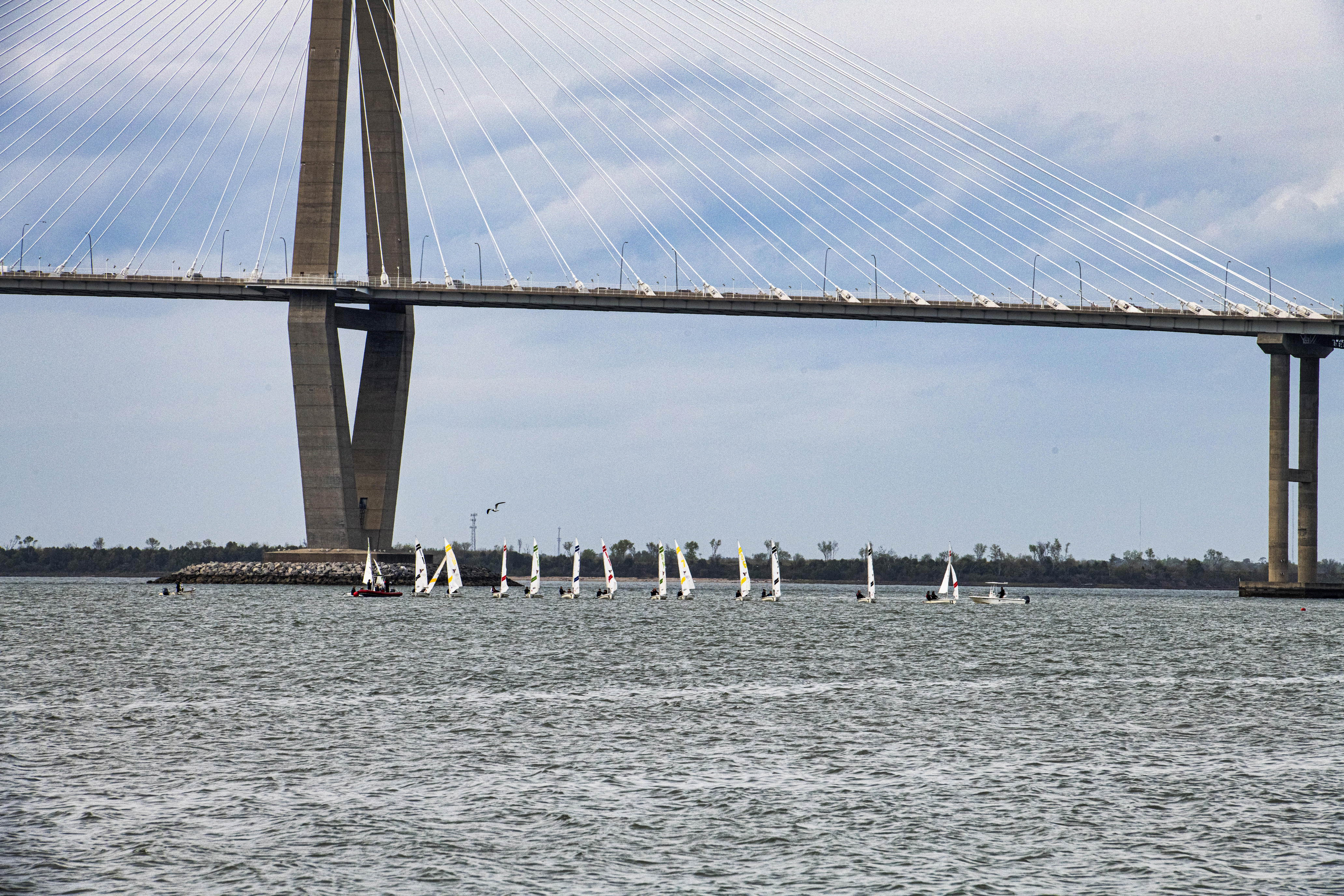
We took several tours to explore the area, the first being the Water Taxi, which runs people across Charleston harbor. We watched two tugboats move a giant cruise ship into position to exit the harbor. The beautiful Arthur Ravenel Bridge looks like a huge sails from a distance.
Downtown, the City Market was fun to explore for a while, then we took a horse-drawn carriage ride around the old part of the city. Another day, Martha and I walked around the old part of the city. I’m not big of cities, but this one is quite pretty with its vibrant colors, innovative plantings, window boxes, iron works and wonderful, wrap-around porches. Before air conditioning, finding a cool breeze on the porch was essential. Beautiful brick and stone-works abound. These houses are solid. Our carriage guide said Charleston sits on a fault, so there have been plenty of earthquakes, about 10-15 a year, so not only do they have to build strong, but the houses are strengthened by earthquake bolts running through them. There was also the great fire of 1861, so building strong is important. I love the gas lights around this part of town.
Charleston is a lovely city with some beautiful surrounding marshes, islands and four rivers. There is a lot we didn’t see, including our friend, Betsy K, so we hope to return.
We have spent several days exploring reserves, preserves and state parks north of Jacksonville, and there are a bunch. There was Pumpkin Hill on Pumpkin Hill Creek, Cedar Creek and Betz-Tiger Preserve. These are on Pumpkin Hill Creek, so there are various kayak/boat launches. We have wandered roads and walked trails. What we discovered is there are some wonderful horse trails in this area. It would also be fun to kayak. It’s good to be alert when walking trails in Florida. I’m also sure there is some great fishing if you know what you are doing. In the evening Sandra fixed a great dinner of Chicken Picata, asparagas, salad and a nice bread 😊
Just east of Jacksonville, Florida is Kathryn Abbey Hanna State Park is an unusual spot. To its north is Timucuan Ecological and Historical Preserve. In fact there are many reserves to the north and west. There is so much water in this area, it boggles the mind – Back River, St. John’s River, Pumpkin Hill Creek, Clapboard Creek, Trout River, Ribauld River and more. We went exploring some of these reserves, but they are so vast, one could spend a lifetime exploring all the waterways. But then, as often happens, the best was right in our back yard – in Kathryn Abbey Hanna Park, a great blend of beautiful beach on one side and a number of lakes on the other, where birds and alligators abound. While Martha, Ruff and Sandra took a Tuk Tuk tour of Jacksonville, I explored Kathryn Hanna.
Just north of North Beach Camp Resort is a research reserve, so Martha and I drove up to take a look and go for a hike. We spent 45 minutes in the very nice Visitor’s Center with all kinds of fish hanging from the ceiling to make you feel like you were in the water. It also helps identify salt water fish of all kinds. It would be fun to take a boat tour through the reserve. Out on the dock behind the visitor’s center seagulls and pelicans gathered for a nap.
Driving across a dam on the Guana River, we went to the end and went for a walk. Rain was in the forecast, so we took our rain gear. There are a number of trails, but not knowing the area, we opted for the main trail, which started out as a sand road. It’s a very pretty area, and despite the weather, there were a number of other hikers. There are 15 miles of trails, and connects with a 7.7 mile loop in Guana River Wildlife Management Area.
Signage and trail markers are excellentTolomato River
About ¾ the way around, it started to rain. Then it came down really hard, but it was still a great walk
From North Beach, we decided to go to dinner at Cap’s On The Water just north at Vilano Beach. Driving up, a sign said all parking was free valet parking. The parking area was a sandy yard between palm trees. Although we were early, the lot was rather full. They don’t take reservations, so we checked in and gave our name, then walked out back to the end of a pier and sat on a bench. Two waitresses were posted there to order drinks, a nice touch. I looked at the smiling lady next to me and asked what she was having. She said it was an excellent margarita. I ordered a manhattan, but Martha, Sandra and Ruff ordered margaritas. We all toasted, and to be neighborly, we toasted our new neighbors.
After a few minutes, I glanced over to see our new friend’s drink was half gone. I asked if it was a good one. “Oh yeah, but I have to be careful. Tequila makes my clothes fall off”. Well that broke the ice. Probably a reference to Joe Nichols’ country song, “Tequila Makes Her Clothes Fall Off”. Her husband rolled his eyes. They sold their house in Albuquerque, NM, bought a class A camper and have been traveling for a year and a half. They have gotten a hotel room and dinner out to celebrate her birthday.
Before long, we were talking like old friends, learning about the children, jobs and all kinds of stories. Cindy and Dennis were their names, and we were disappointed when a waitress came to say their table was ready. Not long after, we were called for dinner. Ruff must have enjoyed his drink because he paid for ours as well as his. By the time Ruff and I got to the dining area, we couldn’t find the girls. Shortly Dennis came up and said they had found a table for all of us.
Dinner was excellent, looking out over the Tolomato River and continuing our conversations. We enjoyed the bubbly Cindy with the huge smile and outgoing personality. Then she told us about her cancer, a rare form of cancer, but she was going to beat it, and had already been through chemotherapy. How could that be? We exchanged contact information as we paid our bills. I was sorry Ruff didn’t pick that one up too.
Outside we waved goodbye as the valet brought their car. We continued talking as we waited for our car. After a few minutes the young doorman pointed to a car with open doors and asked,”Isn’t that your car?” We reflected on an evening that will stay with us for a long time. I hope we cross paths with our new friends again.
It’s next to impossible to get a campsite in Anastasia State Park to the east of St. Augustine. Only Jane B knows how to get it done! Although we love North Beach Campground, we drove over to Anastasia to check it out. The campground is excellent, and there are two main attractions – the beach and a big lake. It is also nice being close to St. Augustine. We went for a long walk on the huge, flat, peaceful beautiful beach, where there are no houses or hotels for four miles. The alternate mode of travel was the bicycle, or even better, an electric bike with fat tires. This is one of the prettiest beaches I have ever seen. I can’t imagine what it is like in warmer months.
On the way back to town, I stopped at a car wash and washed my filthy truck. We stopped at Ace Hardware for a new thermometer for the outside of the trailer. Then we met Sandra and Ruff at O’Steen’s Restaurant for lunch. We have eaten there before, and it is truly unique. They are always busy, with lines outside. We checked in and sat on the bench outside. I asked a fellow, who looked the part, which bike was his. He said the red one. It’s bike week, and they had enjoyed the ride up from Daytona for lunch at O’Steen’s. I sat next to a young man who rode a different kind of bike – a bicycle – with his grandfather. Four ladies were dressed nicely and had obviously been here many times before, as the the lady keeping track of the line knew their names. We were still sitting when they came out from having their lunch, toting little leftover boxes. I offered to buy one, but got no takers.
From last year
After serious study and debate, we all ordered the lightly battered and butterflied shrimp. They also have great vegetables and hush puppies. It’s where we learned about Datil sauce, made from local Datil peppers.They are great shrimp! Great service, great food at a good price. It’s on my favorites list.
Mark Zablotsky told me to go to the Alligator Farm. Then my acupuncturist, Deborah Farley, said she couldn’t wait to go to the Alligator Farm. So off we went, not really knowing what to expect. How are there migrating birds at an Alligator Farm in St. Augustine? We walked around for the first 15 minutes, looking at alligators, lemurs, parrots, ducks and other things. Then we came upon a boardwalk winding through a lake. Trees were loaded with birds making their nests. Birds were flying everywhere. They weren’t caged, free to come and go, but they chose this place to roost. They are so used to people walking around, they were totally at ease. There is another advantage. No predators are going to swim past the gators to get to their nest. I could have spent the day there, but I was still able to get a lot of good shots. What a cool place!