Category: Campgrounds

Great Sand Dunes National Park and Reserve

Saturday, June 25, 2022

Saturday, June 25, 2022

50 degrees as dawn. Maybe a high of 65. 

I didn’t know what to expect when I booked Great Sand Dunes other than there were massive sand dunes with a stream running along the edge. But we are here to see national parks and monuments and this is the first one on our way west. 

I booked three nights at Great Sand Dunes Oasis RV Park. I knew we would need a break from four days of driving. In another location, it might be described as a gravel parking lot, but it sits on a plateau overlooking the massive San Luis Valley, a high elevation desert at 7,694’. They have it all – RV campground, cabins, lodge, gas station, store and a restaurant. 

It is certainly a strange thing to find massive sand dunes in the Rocky Mountains. There is a massive wall of mountains that are in a curve. Winds are quite intense here. The prevailing westerly winds blow across the valley floor, pushing sand up against this mountain catcher’s mitt. They shift, flow and yet the measurements of the peaks haven’t changed much in 140 years.

Also unique is having three streams run past the dunes. As the stream hits the sand, it seeps into the sand and goes underground just past the dunes. 

Martha fixed a great breakfast of sauteed peppers, onions and tomatoes with a splash of vinegar, coriander and cumin. She made wells and cracked eggs into them. Yum!

We went to the Visitor’s Center, a pretty adobe building. It is a nice store with some interesting books. The views form most Visitor’s Centers are great, and this was no exception. It is perfectly located. 

Totally unprepared for the day, we walked across the stream, which consists of ribbons of water an inch or two deep, Martha in her Keens and me in my hiking shoes. With wind blowing from the East (a storm wind), we plodded up the dunes to a level I felt was sufficient and watched others sliding down the dunes on boards designed for the purpose. Others climbed to the very top – 750’. With elevations at 8ooo’, we felt the effects, heart racing, breathing impaired and slightly dizzy.

We drove through the park campgrounds, which were nice, but I like our spot better. It’s a weekend, so every site was taken. There is a dirt road going through Medano Pass. I talked to a man at the Visitor’s Center, who was putting air back into his Jeep tires after coming across the pass this morning. I asked if my truck would make it, and said, “about half way.” My GMC is not an off-road vehicle, although it has four wheel drive. I only drove up it a short distance before realizing this would not be a good idea.

We did drive to a small parking lot where there is a 2.5 up-and-back hike to a view point. Again, the altitude affected us. The views at the top were rather spectacular. 

After lunch clouds and rains came, so we enjoyed a quiet afternoon. Martha mad an innovative dinner using the last of the rotisserie chicken. She essentially made a chicken pot pie with out the pie crust, but put it over a nice crusty bread. It was excellent.

In the night, the winds blew like crazy. I had my window open, and the sounds kept waking me up. I had my blanket on and was still cold, but after closing the window, it got stuffy, so I opened it again. By morning, the winds had stopped. I now understand how these sand dunes get built up and rearranged!

Dodge City to Great Sand Dunes National Park

Friday, June 24, 2022

There are three routes to Great Sand Dunes National Park. We took 56 southwest to 160 because I had never traveled it. This was the last big travel day getting to the southwest for our extended tour.

As we drove through working communities of Ensign, Montezuma, Hickok and Ulysses, we drove through serious farm land, land that had to be watered to make it work. Huge windmills covered the area for miles. As we drove on, there was also oil production. A train line went between the towns, loading grain from gigantic silos. The road was also busy with tractor trailers. The communities were more like corporate work areas.

The further west we went, the drier it got. We saw abandoned homesteads, small, stone structures. If Rt. 50 through Arizona and Nevada is appropriately named The Loneliest Road, Rt. 160 to Trinidad might come in second. As the land became drier, even if land was given to people, they couldn’t make it work.

We stopped in the rather abandoned town for a bathroom break. Fortunately, I checked the refrigerator temperature. It was 44 degrees. The gas was not lit, so I turned the refrigerator off, switched propane tanks and turned it back on with no effect. I turned on the gas stove, but the flame was very weak. I know the tanks have propane, but now all kinds of thoughts ran through my head. Did the mice chew up my gas line?

In the small town of Kim, we spotted a big propane tank. Stopping to ask if they did refills, a gentleman said no, but the man across the street sometimes does. Looking across the road, I saw a small, house-type propane tank. I went across and knocked on the door. A gentleman with hearing aids came to the door. “No”, he said, “We used to run the propane business across the street for 30 years, but the new owners don’t do refills.” I told him I thought we had propane, but the flame is weak. He said, “Drive the rig over here. You can turn around in the yard, and I’ll fill it for you.”

Bud was his name, and he is the epitome of a midwest or western gentleman. He also has a camper and appreciates the travel and issues you can have. As he filled the not-so-empty tank, we talked about Kim. There was a pretty stone building across the street that was built by the WPA and is now used by Colorado Highway people.

We thanked Bud profusely, and offered $30 for propane and peace of mind. He took the $10 and refused the $20. 

I loved driving 160 and all it’s changing scenery. I almost hit a big, strong antelope that jumped in front of us, but then jumped back to the side of the road. The speed limit is 65 and I was going 70, so it wouldn’t have been good. I just got a glimpse of him, but I have a vivid picture of him. Best to have a full tank of gas, water and snacks when driving this road. However, if you get in trouble, there are good people to help. 

We stopped for lunch in Trinidad, then turned north on I-25 for 35 minutes to Walsenburg and turned west on 160 again. Pulling into Great Sand Dunes Oasis RV Park, I was a little nervous. When I called to make a reservation, a young man seemed a bit detached. There was no credit card transaction, and they don’t send confirmation emails. We did have a confirmation number. Thankfully, all was well and we proceeded to our campsite. 

It was 3:00, so I had two or three hours to work on our plumbing issue. I am now pretty familiar with taking it all apart, so I removed the faucet with the attached water lines and tried to blow them out with our air compressor. No dice. I tried flushing with water with no luck. I then pushed a wire up the hose, but it wouldn’t go through the faucet. Maybe I’ll just buy a new faucet in Moab, but we still don’t know if the problem is in the faucet or further down the line. Maybe I’ll connect a hose to the cold water line, run it out the door and turn on the water pump. If that runs strong, I’ll put it on the hot water line. If that runs strong, I’ll go buy a new faucet or get someone to take the lines off of this one.

We sat watching the views and the sun go down from our plateau campground overlooking the valley and Great Sand Dunes. It’s so unique to see huge sand dunes up against the Sangre de Cristo Mountains, the southern section of the Rockies.

Lexington, Kentucky to Columbia, Missouri

Wednesday, June 22, 2022

Kentucky Horse Park Campground

Heading west on I64, it was an hour to Louisville, where traffic was rather frantic. It seems to be the case in most big cities, but it makes pulling a trailer nerve-wracking. That said, downtown Louisville is very pretty, and the Ohio River had great color.

Once we crossed the river, we were in Indiana, crossing the bottom of the state. Traffic was still busy, but we stopped at the only rest stop in Indiana – on 64 anyway. Then into Indiana, where there were beautiful farmlands. So we started in Virginia and have traveled across West Virginia, Kentucky, Indiana, Illinois and then Missouri. 

Crossing the great Mississippi into Missouri, I64 merges with I70 at Wentzville just west of St. Louis. We passed Lake of the Ozarks, and my old stomping grounds at Fort Leonard Wood, Missouri. So many memories, education and fun in one year! Still dating, Martha and I would meet in St. Louis and have a big time in the big city.

We finally arrived at Cedar Creek Campground, just east of Columbia, Mo. It was a dusty road going in. This is mostly a travel campground, where we could still hear the interstate traffic. It was 95 degrees and hot, but I was having a problem. The galley faucet only dribbled water. The bathroom faucet worked fine. The toiled flushed fine. It was only 3:30, so I dove into the project. 

First I removed the strainer on the faucet, which was full of little, brown stuff, but that didn’t fix it. On Martha’s suggestion, I removed the under-the-sink water filter and bypassed it. Still only a dribble of water. removing the filter, I was surprised to see seeds! Mice could only cause this problem. Were they in the trailer? 

I had recently had a new fresh water tank installed at Airstream of Virginia. How could this be? Thinking back, I had bought the water tank from the Mother Ship, the Airstream home in Jackson, Ohio. I was surprised to find it unboxed and dirty, but apparently, that is the way they ship them. Thinking I would do the job, I had it sitting out at the RV storage lot for maybe six weeks before I contracted Airstream of Virginia to do the work. With holes in the tank for connections, Mice would have loved their new food storage place. 

Disconnecting lines, I think I have narrowed it down to the relatively short faucet lines. I took the faucet off, but couldn’t see how to disconnect the lines from the Moen faucet. It was getting late and it could take a couple more hours to sort this out, so I put it all back together and poured a glass of wine. 

The next morning I did some searching on the internet for directions. I got some ideas, but couldn’t really see how to disconnect the water lines where they go up into the faucet. I think I will disconnect the lines under the sink, then remove the faucet with the lines attached and see if I can blow them out or flush with water.

Heading to The Southwest

Tuesday, June 21, 2022

We are starting a trip to the American southwest. It will take four 7-hour days to get to the first of many national parks and monuments. There are also some great state parks, and the more I study the area, the more interesting things I find. Karen and the kids will be joining us for two weeks starting July 1st.

The first drive was to Kentucky Horse Park in Lexington. During my eventing days, I spent a lot of memorable days there. The campground is very nice and has all the amenities. We took a walk around the equestrian area. There have been so many additions, I hardly recognized it. Hard to believe it has been 30 years since I rode here at the peak of my eventing days. My wonderful thoroughbred, Passion, and I placed sixth at the preliminary level, missing an easy, little jump that could have put us in the top four. Passion wasn’t crazy about dressage, and I was rather unschooled in it, so we were in last place after dressage. To finish 6th after that beginning was pretty cool.

Some people were unloading their gear from some very elegant horse trucks. We stopped to talk, and they told us there was a carriage competition starting Thursday. They had a perfectly matched team of four horses. Peeking into the truck, we drooled at a gorgeous, large carriage. It would be so much fun to see this competition. I’ll have to watch their schedule, as they host lots of events, the biggest being the Rolex International 3-day Event.

Approaching the stadium is a very cool statue of the great Bruce Davidson, an incredible 3-day rider. He was Eventing Association’s Rider of the Year in 1975 and then for 14 consecutive years! 

Jumping into water or over a steep drop, Bruce gives a great release of the reins and balances for the landing

Walking through the inside of the beautiful stadium, I felt like I was at the Horseshoe at Ohio State – well not really that big. There was a walk of fame with pictures and stories of some of the legends of jumping and 3-day events. So many great stories, horses and riders! I could have read them all, and we didn’t even go into the museum! We’ll have to come back!

Buccaneer State Park

Saturday, April 30, 2022

I got up early, fixed some coffee and listened to some birds not far away. Although I couldn’t tell what they were, they sounded big. Looking at Google Maps, I saw a big lake or inlet next door. There was also a creek close to my camp. No wonder there were mosquitoes. I drove out of the park, turned right and followed South Railroad Avenue going behind my camp site. There was a train track on the other side of the road. 

The Gulf from South Beach Blvd.

As I slowed down to look at the big estuary, a man got out of his car in front of me. I pulled over behind him, thinking I would take pictures of some egrets or something similar, but there were none. The man started rigging up a fishing rod, so I walked up and asked what he was going to fish for. 

In his mid-sixties, he put a Hula Popper on as he told me he came here every morning for an hour’s fishing while his wife slept. He said he sometimes caught sea trout, flounder, largemouth bass and drum. “OK”, I thought to myself. “I think I’ll hang around and watch.”

This guy was a pro. He had a Daiwa rod and a Japanese reel, braided line and a tippet he tied onto a loop at the end of the line. As we talked, he must have thrown one of two lures  200 times, and never got caught in the grass once. He could throw that thing a long way with a two-handed grip with the lure dangling 2.5 feet below the end of the rod. He knew the currents and the wind, so he threw it past and left of a point. The current would carry the lure right past the point. It was pretty-much high tide, his favorite time to fish.

Fish began jumping to our left and further out. I suggested he needed a boat. “Ahh, I used to have one, but now I’m too old and sore to pull it out. I sold it last year.”  The jumping fish were bait fish trying to escape some predator. Sea gulls cried above, swooping down to capture some. 

Finally, we introduced ourselves. Stephan Champagne (pronounced with Creole accent). He was born and raised in New Orleans, but traveled a lot with business. He worked with the railroad for years, and said this is still a busy line carrying all sorts of goods – whatever someone wanted to have shipped. He worked in Newport News for a while, installing a system for ship building that was a big success. 

Finally he got a hit – a good one. He had switched to some 2.5” topwater crawler he gave me the name of, but I no longer remember. It was a very nice trout. He quickly dispatched it with a knife to the spinal cord and threw it into a cooler. “Dinner”, he said with a smile. He said he preferred topwater lures. “It’s just more fun.” 

After a few more casts, he looked at his watch. His wife would be getting up, so he started packing up, and we said our goodbyes. I enjoyed my morning with Stephan, and I think he liked having some company. I liked his stories as well as watching an expert fish. He talked about his 40’ mahgany trawler he bought and restored. He and his wife enjoyed traveling in it for about 7 years before he got tired of throwing money at it.

I stood looking at this pretty piece of water, imagining a nice fishing kayak, maybe one you power with your feet. Maybe I could get to the other side where all the fish seemed to be. Then again, maybe Stephan was right. Drive up, throw lures for an hour in the early morning, watch the gulls and maybe take a nice fish home for dinner.

Driving to New Orleans

April 28, 2022

Next week I am doing a 5-day photography/cultural workshop with Mark Zablotsky Photography in New Orleans. Mark lived in New Orleans for two years while doing his Periodontics residency in the 80’s, and he has been back many times for continuing education. 

I could have flown down, but didn’t want to, or I could have taken the train, which I strongly considered. It would have been cheaper than driving if I didn’t get a sleeper. A sleeper pushed the price to $507, so I opted to drive.

I thought about taking the Airstream, but a hotel is included in the price of the course. In my many campground stays, I have often wondered what it is like to stay in cabins or tents that are so often in campgrounds. They seem rather under-utilized, so I thought I would give them a go. 

Sweetwater, Tennessee is an hour short of half way to New Orleans. Actually I thought it was half way, but I didn’t factor in the time change, which happens just east of Chattanooga, Tennessee. I had booked a small cabin at Sweetwater KOA, not far off I75. The costs are about $77 without plumbing and $110 with plumbing. I thought I would try it without plumbing, which means no sink or shower, but I would later learn there is a faucet in front of the cabin.

It’s a bit like camping with the trailer, using the bathroom for showers etc, but in the middle of the night, the treck to the bathroom is cumbersome. Cooking is more like camping with a tent. All in all, it was a nice little cabin, and I slept well.

I liked the little reading light
The cabin was called Dolly

I chatted a while with the owner of this beautiful camper that isn’t made any more.

I was up and out early, but I had to go into town for gas and DEF. I went into Skinner Auto Parts Store at 7:00 and it was hopping. Sweetwater is a town of 6300, but looks smaller. I think everyone was in the auto parts store, and they all knew each other. A nice man behind the counter asked what I was looking for, and he pointed to the DEF right by the front door. He greeted two others by name before pointing to the Diesel Clean on aisle 10. After I paid he carried two containers of DEF (diesel exhaust fluid) out to the truck, set them down and said goodbye. Two small groups were talking in the parking lot. A donut shop next door caught my attention, so after filling the DEF tank, I went over and got a couple of donuts and coffee. I think it was the owner sitting at a table who thanked me as I walked out. What a nice, little town.

Sweetwater, Tennessee

Back on I75, traffic was busy on this Friday. Chattanooga was busy, but Birmingham was more busy with road construction making things come to a complete stop several times. By the time I got to I59, things got less hectic. I pulled into Buccaneer State Park at 5:15. A young man showed me to my Tentrr and wished me well.

I had visions of exotic tents I had seen pictures of in Africa, but it wasn’t exotic. It was a nice tent on a wooden platform with two chairs out front. Like the KOA cabin, there was a bed inside and a picnic table and fire pit outside. 

I went out of the park, along the gulf coast and turned toward Waveland and went into Da Kitchen Too restaurant. It was rated a 4.3, and I envisioned home-style black cooking. It was not. It was hopping on Friday night, and the all-white staff couldn’t keep up. A young girl pointed me to the refrigerated cabinets to get my own beer. The food wasn’t worth waiting for.

At my Tentrr, I poured a glass of wine, and started to relax when the mosquitoes came out. I retreated inside the tent. Tired from two days of driving, I went to sleep early. I vaguely heard a train horn in the distance. It progressively got louder until I thought it was coming through the middle of the tent! I could feel the rumbling of the train. I sat right up, trying to remember if there was a train track coming through camp. Fortunately it rumbled on by and I went back to sleep. Two more times trains came by in the night.

Oakland Plantation

March 22, 2022

The day began with Red and White Market sausage, eggs and pancakes. That sausage is so good!

Mt. Pleasant/Charleston KOA is owned by adjacent Oakland Plantation, which has been in the family for several generations. At 236 acres, it isn’t big, but it is very pretty with its Oak-lined entrance. The campground provides a free tour of the property in a tractor-drawn wagon.

Since Ruff ordered the best drink, we had to try it

Magnolia Plantation and Gardens

March 21, 2022

Mark Zablotsky (https://www.markzphotoworkshops.com) had recommended Magnolia Gardens. I knew little about it, except that there is a 60 acre Audubon Preserve. A big sign in front listed all the tours. Martha asked what I wanted to do, and I said, “All of it.” We started by walking through the extensive gardens. Extracting from https://www.magnoliaplantation.com/magnolia_history.html,

“Some time later, while in England preparing for the ministry, young John Grimké Drayton received word that his older brother Thomas had died on the steps of the plantation house of a gunshot wound received while riding down the oak avenue during a deer hunt. Thus, having expected to inherit little or nothing as a second son, young John found himself a wealthy plantation owner at the age of 22.

Despite the prestige and wealth inherent in ownership of Magnolia and other plantations, he resolved still to pursue his ministerial career; and in 1838 he entered the Episcopal seminary in New York. While there, he fell in love with, and married, Julia Ewing, daughter of a prominent Philadelphia attorney. Returning to Charleston with his bride, he strove to complete his clerical studies while bearing the burden of managing his large estate. The pressure took its toll, and his fatigue resulted in tuberculosis. His own cure for the illness was working outside in the gardens he loved. He also wanted to create a series of romantic gardens for his wife to make her feel more at home in the South Carolina Lowcountry. A few years later, as though by a miracle, his health returned, allowing him to enter the ministry as rector of nearby Saint Andrews Church, which had served plantation owners since 1706 and still stands just two miles down the highway towards Charleston. But until his death a half-century later, along with his ministry, Rev. Drayton continued to devote himself to the enhancement of the plantation garden, expressing his desire to a fellow minister in Philadelphia, “…to create an earthly paradise in which my dear Julia may forever forget Philadelphia and her desire to return there.”

After walking through the gardens, we took the house tour. No photographs were allowed. Although the house isn’t grandiose, it is comfortable, and the huge porch is wonderful. The original home burned three times, once by Union troops. It was rebuilt as a cabin at first, then gradually, additions were made. The property is still owned by the family through 12 generations.

From https://www.historians.org/publications-and-directories/perspectives-on-history/summer-2016/the-other-drayton-hall-south-carolina-plantation-architecture-in-the-documentary-record

“After the Civil War and through the Civil Rights Movement Magnolia continued to function, though in a distinctly different way. Among the many challenges was establishing a new relationship with the formerly enslaved workers who remained on the plantation as sharecroppers, tenants, and day laborers. All of Magnolia’s residents worked to find a new level of social and economic understanding and accommodation. The plantation’s main house was rebuilt in the 1890s. Increasingly mechanization would replace the need for tenant farmers; what began in the 1930s was accelerated by World War II bringing the end of plantation agriculture at Magnolia. In spite of difficulties the African American community still maintains a strong presence in the Cane River region. Traditions rooted in African, French, Native American and Spanish influences give this area its character.”

Next we hopped on a trolly that would take us through the Audubon Swamp. They have built ramps in the water where alligators, birds and turtles sit. The trees were loaded with roosting Egrets, Great Blue Herons and Anhingas. John James Audubon spent time here, studying and painting wildlife. Some of his work hangs in the house.

Fortunately, we brought sandwiches and snacks, so we had a quick lunch before the boat tour through the rice fields. Thomas and Ann Drayton came to Magnolia near “Charles Towne” in 1676, having made a fortune with a sugar plantation in Barbados. They tried many things including sugar, but none worked in this unique land. Finally they they found success with rice, namely Carolina Gold Rice. Cultivating rice was the most dangerous kind of farming there is. Several on the boat tour simultaneously asked, “Why?”. The slaves walked through this flooded 60-acre field where it is hot, out in the sun. There are alligators all over the place. Cottonmouths live here amongst other snakes. Mosquitoes carried yellow fever, but the most deadly was a cut, which could become quickly infected in these stagnant waters.

Now the fields have returned to marsh, which is a wonderful place for wildlife. It still has gates to control the water. As a duck hunter, I had visions of ducks flocking into flooded rice fields.

After this tour, we went for a walk through the Audubon Swamp. Photographers with tripods were wandering trails and boardwalks. What a cool place in this blackwater swamp where Audubon himself once roamed.

On the way home, we stopped at Mt. Pleasant Seafood to get something to cook for dinner. You don’t know what you are doing when you walk into an unfamiliar place, even though it is highly rated. I wandered around while I listened to Martha ask the nice, patient lady what she recommended for a fish to cook over an open fire, and how to do it. She recommended a Red Snapper that would be big enough for four. I came up to join her and noticed the oysters and asked for a dozen. I was impressed by the knowledge, patience and enthusiasm of this lady. Later I would learn she is an owner, Sarah Fitch. For 75 years and four generations, the family has run the market. From an article in Mt. Pleasant Magazine:

MPM: When did you decide to go into the business you are in?

Fitch: Mount Pleasant Seafood first opened its doors back in 1945, on the banks of Shem Creek, with my great-grandfather and grandfather, Captain Walter G. Toler and Captain Walter D. Toler. For four generations now, we have been serving fresh local seafood to both our local community and tourists from around the world. Whether it’s the fresh catch of the day, the Ready-to-Go Shrimp Boil or we are catering a special occasion, we are extremely grateful for the opportunities that allows our family to serve others.

MPM: How do you find your passion?

Fitch: I wouldn’t say I found my passion, but more so I was born with it. From the time I was old enough to shuck an oyster myself, I fell in love with our family’s legacy and the people of this community. It was a natural fit for me to assume this role and work hand-in-hand with my family, doing what we love to do.”

MPM: What or who inspires you?

Fitch: “My family’s history inspires me and the future of our community motivates me. Along with sharing recipes and smiles with the folks we serve, I equally enjoy working with today’s youth, both within my church community as well as inside our market. To me, the greatest thing we can do to ensure the success of our future is to create a space for them to learn and grow. I believe we do this well at Mount Pleasant Seafood.

MPM: Tell us about how you grew up and who shaped you into the woman you are today.

Fitch: I’ve been fortunate to grow up in a family that has taken pride in hard work. Also, even with our community growing larger and larger by the day, there is a small-town sense about this place that instills care and concern for our neighbors and environment. I think I’ve benefited greatly from my family and community all around.

MPM: Give us some success tips for someone just starting out in your line of work.

Fitch: Keep your eyes and ears open all the time. The natural resources around us are incredible, as are the men and women cultivating the waters for our seafood. Listen to their stories and learn the rhythms of seasonal products to fully enjoy everything the Lowcountry can provide. When we know what goes into the art and hard work of harvesting local seafood, I think it tastes even sweeter and tastier.

For more information on Mount Pleasant Seafood, visit mtpleasantseafood.com.

We had cocktails and dinner enjoying outstanding oysters, while Martha cooked the Red Snapper to perfection. It was a great day.

Charleston, South Carolina

March 2022

We stayed at Mount Pleasant/Charleston KOA while exploring the area. This is a nice KOA with a great staff and facilities on a pretty lake. It is part of Oakland Plantation and managed by the family. A small creek ran behind our campsite and there are woods behind that. Each morning and evening we were greeted by a Barred Owl singing “Who cooks for you?” I never did see it, although I looked hard. Ducks and geese like this little creek, and it has a good population of 5-inch fish and minnows. Unique to this campground, the geese fly down Main Street about 6 feet in the air every morning from the lake, and then back at 5:30 in the evening.

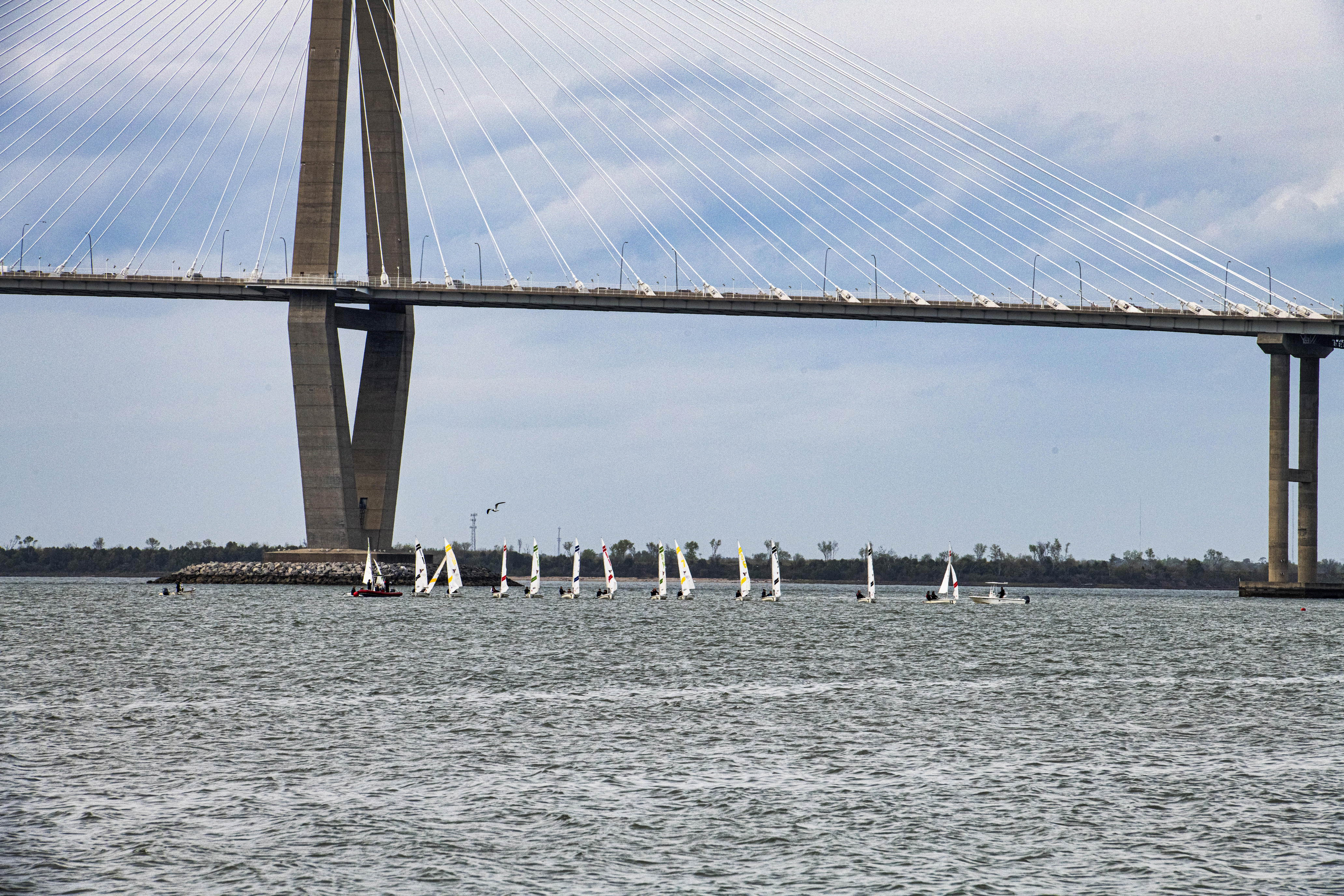
We took several tours to explore the area, the first being the Water Taxi, which runs people across Charleston harbor. We watched two tugboats move a giant cruise ship into position to exit the harbor. The beautiful Arthur Ravenel Bridge looks like a huge sails from a distance.

Downtown, the City Market was fun to explore for a while, then we took a horse-drawn carriage ride around the old part of the city. Another day, Martha and I walked around the old part of the city. I’m not big of cities, but this one is quite pretty with its vibrant colors, innovative plantings, window boxes, iron works and wonderful, wrap-around porches. Before air conditioning, finding a cool breeze on the porch was essential. Beautiful brick and stone-works abound. These houses are solid. Our carriage guide said Charleston sits on a fault, so there have been plenty of earthquakes, about 10-15 a year, so not only do they have to build strong, but the houses are strengthened by earthquake bolts running through them. There was also the great fire of 1861, so building strong is important. I love the gas lights around this part of town.

Charleston is a lovely city with some beautiful surrounding marshes, islands and four rivers. There is a lot we didn’t see, including our friend, Betsy K, so we hope to return.

Betz-Tiger Point Preserve

We have spent several days exploring reserves, preserves and state parks north of Jacksonville, and there are a bunch. There was Pumpkin Hill on Pumpkin Hill Creek, Cedar Creek and Betz-Tiger Preserve. These are on Pumpkin Hill Creek, so there are various kayak/boat launches. We have wandered roads and walked trails. What we discovered is there are some wonderful horse trails in this area. It would also be fun to kayak. It’s good to be alert when walking trails in Florida. I’m also sure there is some great fishing if you know what you are doing. In the evening Sandra fixed a great dinner of Chicken Picata, asparagas, salad and a nice bread 😊

error: Content is protected !!